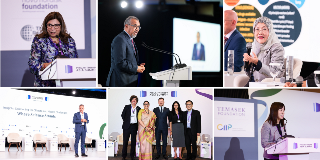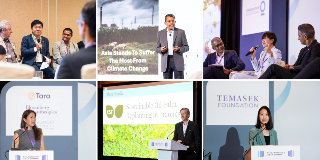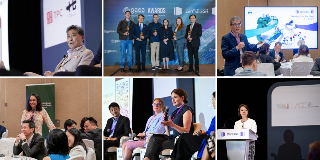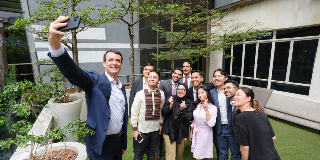
The algorithm accounts for roughly 10% of a digital solution’s success, and data and infrastructure for another 20%. Change management makes up the remaining 70%, which means redesigning how a service is delivered and persuading people to use it. That rule of thumb was shared at a closed-door roundtable on AI for Good in Asia during Climate Week NYC 2026. Philanthropy Asia Alliance (PAA) and Equinix Foundation co-hosted the session with BCG at Equinix’s New York office. Funders, technologists, researchers and implementers compared which AI deployments had lasted beyond their pilots, and why.
Participants agreed that AI scales when four conditions are in place. A tool must solve a clear problem, fit into a service people already use, earn its users’ trust and have an owner able to keep funding and running it. Teams often begin with the algorithm, yet AI produces results only when a farmer acts on its recommendation or a teacher uses its assessment to adjust lessons. Planning has to reach that final step, since even wide adoption cannot guarantee it’s translation into outcomes.
Start with the problem, then size the model to fit
When AI Singapore began its language work, Southeast Asia’s more than 1,300 languages made up less than 1% of the data used to train major AI models. Closing that access gap defined the project, and the technology was chosen to fit it.
A global coalition of 60 organisations, including the Gates Foundation and AI Singapore, recently announced a five-year goal to help an estimated 3.4 billion people use AI in their own languages and voices. The work spans data, models, benchmarks, and on-the-ground implementation, a range no single funder could cover alone. That’s why the coalition includes AI labs, governments, philanthropies, and locally led groups, and why others are invited to join.
Participants also pointed funders towards smaller, fit-for-purpose models, which receive less attention than generative AI. They cost less than frontier systems and are easier to explain, and they often suit lower-resource settings better.
The teacher keeps the final word
Wadhwani AI built its literacy tool to ease one classroom burden in Gujarat and Rajasthan, the effort of assessing how well children read. As a pupil reads aloud, the software rates four skills, recognising letter sounds, blending them into words, reading in meaningful phrases and fluency. Teachers use the results to plan remedial lessons for each child and can override any score.
The assessment runs inside government applications schools already use and follows existing classroom routines, so staff need fewer separate tools and new processes. Built that way, it has completed roughly 42 million assessments in more than two states at under one US cent each. Because it relies on state infrastructure, it kept working through a period of regional conflict.
Public commitment from day one
Funders have a clear role in financing pilots and early proofs of value. Those trials stand a better chance when government commits at the outset, with policy adoption and handover planned in advance. As one participant put it, funding a pilot first and asking officials to adopt it later falls short of best practice, because the state needs its own stake in the outcome.
Multi-year investment in the skills of public institutions strengthens delivery further. The aim is for government employees to run the service themselves once external support ends. Participants warned that philanthropy-funded programme units can otherwise keep ministries dependent, and that a pilot without broad capability is exposed whenever political leadership changes.
For longer-term financing, the roundtable pointed to multilateral development banks as early partners. Telecommunications companies, many of them searching for a role in AI, were flagged as an underused route to users. In markets where telcos already have wide reach and customers’ trust, they could distribute proven tools.
What one deployment teaches the next
MahaVISTAAR, an AI advisory service for farmers, was built by the Government of Maharashtra with support from the Gates Foundation. It took nine months. Ethiopia drew on that experience to launch a comparable service in three months, and Amul, a dairy cooperative in Gujarat, did the same for a voice-based advisory service for farmers in just three weeks. Each deployment moved faster than the last.
With AI, participants said, a programme can now achieve in three months the impact that traditionally took three years. Building a national learning assessment once required two and a half years; AI-enabled tools now complete the task in months. Donors can widen a tool’s reach by backing its adoption by one government, its use for related problems or its adaptation elsewhere.
Several funders expressed interest in a shared library of proven solutions and implementation lessons to make such transfers easier. PAA will work with Equinix, BCG and other partners to build a portfolio of promising AI for good use cases in Asia.
Fast scaling carries risks that are not yet understood, especially where fewer people check what an AI system decides. Early randomised studies have raised concerns about cognitive effects, and it remains unclear whether some AI tools help children as intended. The roundtable’s advice was to keep safety ahead of speed and reserve rapid deployment for urgent cases such as humanitarian response.
Where philanthropy can make a difference
Grants that stop at the algorithm cover about a tenth of what makes an AI solution succeed. Shared data and evaluation, institutional capability, adoption support and long-term financing make up the rest, and philanthropy can contribute most in these areas. Funders who finance those conditions early give a promising tool the chance to outlive its pilot phase, and every deployment they back speeds up the next.